
The world according to the machine
In the paragraph "Here's a thought: AI agents are increasingly used..." [1] the idea of a society governed by machine intelligence is advanced whereby the decisions are taken out of the hands of politicians. Given the level of anxiety about the role of AI right now the very thought would be abhorrent to many (notwithstanding the apprehension directed towards politicians in any case). But what are we in fact dealing with?
Any decision we make is based on our representation of something. What we make of an object, a scenario, a thought, how we see all that forms the basis of our understanding. However, it can go wrong due to the inherent limitations of our brains.
For example, to ascertain the usefulness of a new tax its immediate impact upon a section of the economy is considered, but even this view is more or less a broad sweep (and consequently inviting criticism from other sectors). What has not been done is the detailed examination of every single member of the economy in order to predict what it would mean to them. The data are not available to begin with, and even if they were the resources to process them are found wanting. To have at least some idea a certain focus is applied, concentrating on a sector which suggests itself. The rest is left untouched.
Since the economy is a complex dynamic system (see A guide to an enigma [2]) any one of its elements interact with the rest such that there are often unexpected consequences depending on the degree of affinity between one and some other element (which then would be pointed out by critics of the new tax). For the unexpected to be kept at a minimum the initial evaluation needs to be sufficiently comprehensive.
Note that the comprehensive evaluation does not need a particular focus at that stage (which in any case would be a form of presumption), simply because the relationships are identified there and then as the evaluation proceeds. Once a relationship has been found, further detail can be extracted (a focus from then on).
In itself this approach is nothing new. Applying quality control during manufacturing means testing an object within the radius of a certain process; when trialling a computer program its modules are examined in terms of their mutual compatibility. We observe a processing space and the functional parts within it.
The Teddy factor
Emotional attachments are a one-way street. A child loves a toy regardless of the toy's composition; the toy doesn't love back.
Garfield's lovable teddy could be made of (clockwise from top), nylon, LC3 monomer, or wool fibre as in the accompanying image [3] - it's still Pookie as far as Garfield is concerned.
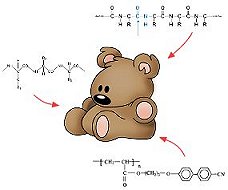
Similarly, an object powered by AI will invite an emotional response depending on the context in which it is handled. Children can have such advanced toys, and adults can engage emotionally with the object if packaged accordingly (a robot in a nursing home, for example).
The adjective defining an emotion is provided by the human user; the object itself is independent of that process. If something is termed 'nice' from the start, chances are there is no analytical follow-up and the same goes for anything negative.
The emotional overlay can be quite powerful. To what extent it can influence the human mind is a matter for that mind's analytical capability and the will to employ it. Negative adjectives are often used on purpose although the target itself can be quite harmless.
A society is obviously more complex than a factory or a computer program. At that scale the problem is not the data themselves, it is the process of their collection and subsequent evaluation as a whole. A flow chart alluded to in the section The resource relationships chart [4] would be good way to start to make the consequences of a tax for example clear (make that an interactive flow chart to allow end users to play around with their own ideas). What such a chart would not necessarily highlight are the choke points in terms of the system's overall sustainability. For that a deeper analysis is required based on more comprehensive data.
It seems agentic AI is already capable of delineating from given expressions by ascertaining the abstract version and then reformulating their meaning. As a test I have used Google's AI mode [5] (text) and typing the question "who is martin wurzinger and otoom?" into the field *).
*) Any question is possible of course, but this way I could check the result against my own records. (By the way, I am not related to Google.)
The words "Martin Wurzinger is an independent Australian researcher ..." do not appear anywhere on my website but would have been generated by trawling the internet for clues (screenshot).
Under "What is Otoom" > "The Software" the sentence "He designed custom simulation tools, such as the OCTAM program (an artificial mind model relying on camera/microphone inputs and OtoomCM ..." also displays the abstractive ability of the algorithm. Similarly, the Otoom Fractal under the question "the Otoom fractal under the Otoom Mind Model" is correctly described although I have not used those exact words myself (screenshot). In particular note the emphasised sentences in the screenshot; they are a very well expressed summary rendition of the concept. The entire response took just under 1 second to generate.
Another example of an AI conversation is US-Iran war - the 10 axioms of society. Although a different topic, it does demonstrate how Google's AI mode maps the formulation of the 10 axioms of society to current events.
A cognitive process does not inherently contain any subjective interpretations, although the background to that process would act as a prompt to particular preferences which in turn could well find their way into the resultant expressions. Such relationships have been tested for. Examples are described in The mind behind the machine: Unveiling the ideological vulnerability of generative AI [6]. As the subtitle suggests, the article deals with generative AI, not the agentic version. Given the abstractive ability of the latter it is doubtful whether an ideological background would substantially change its output. At best it would be mentioned as a particular part of the whole. Nevertheless, how reliable can one expect a background to be?
For a general informative environment to act as a balance against exceptional sentiments the former needs the necessary range of data. Just as a human being can be radicalised if isolated from wider society, an AI agent needs to be exposed to more information than a temporary focus would warrant. As the above interaction with Google's AI Mode has shown, the greater volume can be handled although I should point out that I am not aware of any adversarial comments about the Otoom model which then could be compared with the final result.
Consider the flow chart mentioned previously. As a basis for the movement of money across the various functional entities in an economy and each with their specific cost-effective parameters situated within the overall system, it serves as a borderline-setting template should any of its metrics fall outside the sustainability envelope; exactly what is at the core of debates on government expenditures; a familiar scenario come budget time.
(Just about all governments of industrialised nations suffer from budget stress. As British MP Pat McFadden so succinctly put it: "Every meeting I have is 'who can we tax in order to pay benefits to others'" [7].)
The reasons for not taking the exceptions into account would be either ideological or can simply be a matter of ignorance. As to the latter, a highly complex economy requires the comprehensive oversight, which is what agentic AI seeks to deliver. When it comes to ideological perspectives, the borderlines become more diffused - if restricted to the ideational that is. Whatever the first impression of an idea may be, as soon as it is implemented any shortcoming will show itself. The shortcomings will be identifiable by the actual data on the other side of the sustainability envelopes.
Such can be the hold of an ideology on a person's mind that even at that point no alternative will be considered; the cause of altercations throughout history. As long as ideas are confined to conversations the arguments remain at dinner tables or pubs (or parliaments). Move them beyond towards implementation however and battles in the streets are possible because by now the flaws are there for all to see.
(As an aside, that's why the concept of dialectic materialism - an ongoing evaluation of effects in the material world - has been favoured throughout the centuries. Usually ascribed to Karl Marx and Friedrich Engels (and hence taken to be synonymous with Marxism) the approach itself has been practised for millennia and is still part of any successful enterprise, albeit expressed differently. Over two thousand years ago Sun Tzu in The Art of War [8] referred to the technique.)
If computers are used to evaluate the possible outcomes in complex dynamic systems any functional elements an be grouped as suitable candidates to arrive at a plausible list of scenarios. That approach is already used for weather forecasts, such as the Next Generation Forecast and Warning System (NexGenFWS) implemented by the Australian Bureau of Meteorology [9]. Note the combination: A comprehensive set of weather data, an understanding of their effect, and the calculation of ensuing probabilities. (It doesn't stop there. A similar method is employed when searching for new antibiotics [10], see What did the researchers do?)
Translated into an economy we have the financial data from the society's entities, their sustainability factors, and the state of the entire system as a result. What would not be recognised as a justifiable factor are sentiments based on some secular and/or spiritual ideology and preferences derived from emotion. For example, if a railway line is opposed because it would run over 'sacred ground', the concept of 'sacred' does not feature amongst the statistics of public transport, the availability of goods and their role in production. By the same token, any funds allocated to ensure physical fitness in all schools with its positive (ie, money-saving) effects later in life, would be posited against the income generated by a new stadium serving a handful of athletes with thousands of spectators just sitting there. In all probability the stadium would not compensate for A$2.4 billion - which happens to be the cost of physical inactivity in Australia in the year 2018-19 [11].
The problem has assumed international proportions in the case of illegal drugs. The expenditure by government agencies to counter criminal gangs as best as they can at home and abroad seriously undermine the efficacy of tax regimes, quite apart from the sociological impact. See "Do we still practise colonialism?" [12] for more detail, including the next two paragraphs "The aforesaid raises a rather intriguing perspective..." and "There is more. Behind those dynamics stands...". The factors responsible for the scenario described there are in operation at that very moment.
Most definitely the AI system would not advocate the headlong dive into religious delusions that still characterise the human condition with all their destruction and suffering. Being unemotional an AI agent may not be swayed by the existence of a dismembered human, but it will ascertain the sheer uselessness of cutting up bodies and therefore exclude that from its economic model. After all, in order to arrive at an economic framework one needs facts and figures, not the phantasies of psychopaths. The same goes for dictators *).
*) Where are those mental health experts when you need them? They tie themselves in knots over a kid who doesn't know whether they are boy or girl, but when it comes to crazy on a global scale they stay silent.
On the same note the much-hyped image of the independently thinking human brain as being so very different from a strict protocol-following machine is often a myth. When terrorists shout "Allahu Akbar!" while gunning down people their programmed brains are on display right there. For that matter, any act of torture following a prescribed dictate regardless of the effects on the victim are not the noble act supposedly synonymous with being human. On the other hand, an unemotional, facts-and-figures based analysis of behaviour that is aligned with the sustainability criteria of human activity systems will be rather dry and not be of the sensational kind (someone's destruction can hardly be part of the productive processes of the overall system), but it will point to what we humans call madness.
The Law is an ass
A phrase often used to describe the inflexibility of the law, or its lack of 'common sense' [13].
Laws are not absolute. During the years 1939 and 1945 there were laws that permitted soldiers to kill Nazis. In 2026 having a Nazi in your family does not allow you to kill them (at least in Australia).
Nonetheless, the status of lawyers is reflected in their fees they are meant to charge, their attire even (wigs have always been designed to impress although the effect can be the opposite). In Australia the hourly rates range from A$300 to tens of thousands of dollars [14]. What mainly determines the rates is the level of complexity, the volume of legal information relevant to a case.
That applies to human lawyers. It should be obvious that an agentic AI system can sift through millions of legal data (from around the world even) in minutes, rather than the days or months not to mention the years-long training required for their organic counterparts.
Provided the available information is sufficiently comprehensive, the AI agent can be relied upon to provide sound legal advice without the colourful symbolic authority and financial elevation humans like so much.
Naturally, a certain amount of opposition can be expected. Once any individual can download an agentic AI copy for their own purposes however, even governments will have to come to the party, with their own - desirable - checks and balances in place. Then democracy will be served once again.
It goes further. With the abstractive, that is delineating, capability of agentic AI in mind, how would the status of someone described as "retired lawyer and human rights campaigner Robert Van Aaist, who has been identified as a key mastermind in the return of the cohort from Syria" be assessed [15]. The "cohort from Syria" refers to a group of Muslim women (the so-called 'ISIS brides') who had left Australia to join the ISIS terrorists in the Middle East and who have been assisted to return. If the concept of 'human rights' is embedded within the functioning framework of human activity systems, and there are a bunch of people in whose minds the murdering of all those who do not share their psychopathy is the standard, how can 'human rights' be aligned with the latter. Should someone doing the alignment perform such mental gymnastics after all, their status of citizen with all the rights and privileges would have to be amended. Since according to the above cited article the status has been left unattended, the humans behind that inaction created a blatant discrepancy between the general definition of society and its implementation.
Here is an example of how an AI agent has assessed a text compared to humans, in this case academics. Could it be that some of the opposition to AI comes from individuals who fear having their own biases proven wrong?
As to the question of AI acceptability by the general public, the common warnings appended to the answers to someone's input point to AI's widespread use right now. It seems having text presented as some kind of recognised authority on just about any topic points to the affirmative.
Indeed, AI is increasingly used for decision-making processes by governments. In Australia, here is how the policy is described: "Government agencies are embracing the AI opportunity to boost efficiency, enable better data analysis and evidence-based decisions, and improve service delivery for people and business" [16]. "Better data analysis and evidence-based decisions" leads to making decisions about decisions, the next level. Since nothing can happen without energy, it is to be hoped energy source coefficients such as outlined in "The current aversion to nuclear energy..." [17] would be included sooner or later. How those evidence-based decisions will fare against the corrosive influence of human ideology and superstition is anyone's guess.
Perhaps in the future there will be an initiative akin to the video Flight to a new earth, about a select few travelling to a planet 11 light years away, a journey that takes 150 years [18]. The film ends with a transmission from their old home, left so long ago: "Everything is over on Earth. The climate, wars, famine, everything you probably warned us about, but it's too late now ... Take care of your new world and never come back. End of transmission."
1. M Wurzinger, Here's a thought:, https://www.otoom.net/dontreadthis.htm#heresa.
2. M Wurzinger, A guide to an enigma, https://www.otoom.net/enigmaguide.htm.
3. Garfield and Friends, HiClipart, https://www.hiclipart.com/search?clipart=pookie. Chemical composition of wool fiber (R 5 side chain of varying characteristics), https://www.researchgate.net/figure/Chemical-composition-of-wool-fiber-R-5-side-chain-of-varying-characteristics_fig7_340242305; The structural formula of LC3 monomer, https://www.researchgate.net/figure/The-structural-formula-of-LC3-monomer-PLC3-polymer-and-GLC3-graft-copolymer_fig1_252108024; Chemical composition of wool fiber (R 5 side chain of varying characteristics), https://www.researchgate.net/figure/Chemical-composition-of-wool-fiber-R-5-side-chain-of-varying-characteristics_fig7_340242305; ResearchGate GmbH, Berlin, Germany. Accessed 5 June 2026.
4. M Wurzinger, The resource relationships chart, https://www.otoom.net/axiomssociety.htm#resrel.
5. Google, https://www.google.com/, AI Mode.
6. T McIntosh, The mind behind the machine: Unveiling the ideological vulnerability of generative AI, TableAus, Australian and International Mensa News, Edition 471, May-Jun 2024.
7. K Devlin, Labour split as minister criticises party's attempts to reform welfare, The Independent, London, https://www.independent.co.uk/news/uk/politics/pat-mcfadden-labour-welfare-benefits-dwp-b2988714.html, 3 June 2026. Accessed 4 June 2026.
8. The Art of War, Sun Tzu, Harper Press, London, 2013. A contemporary explanation is provided by General Tao Hanzhang in his book, Sun Tzu's Art of War, Sterling Publishing Co., Inc., New York, 1987.
9. Geospatial World Award for the Bureau's forecasting system, Bureau of Meteorology, Australian Government, https://media.bom.gov.au/social/blog/187/geospatial-world-award-for-the-bureaus-forecasting-system/, 9 May 2014. Accessed 24 May 2026.
10. T Jeffries, Opinion: AI has produced 2 new antibiotics to kill 'superbugs'. It's promising - but we shouldn't get too excited yet, News Centre, Western Sydney University, https://www.westernsydney.edu.au/news-centre/expert-opinion/ai-produced-2-antibiotics-to-kill-superbugs-we-shouldnt-get-too-excited-yet, 20 August 2025. Accessed 1 June 2026.
11. Economics of sport and physical activity participation and injury, Australian Institute of Health and Welfare, Australian Government, https://www.aihw.gov.au/reports/sports-injury/economics-of-sport-and-physical-activity/contents/total-cost-of-physical-inactivity-and-related-risk, 5 September 2023. Accessed 31 May 2026.
12. M Wurzinger, Do we still practise colonialism?, https://www.otoom.net/dontreadthis.htm#dowest.
13. Yes, sometimes the law is an ass, Stacks Law Firm, Sydney, Australia, https://stacklaw.com.au/news/criminal-law/yes-sometimes-the-law-is-an-ass, 3 March 2014. Accessed 8 June 2026.
14. Legal Fees in Australia: 2025 Guide to Major Practice Areas, Brightstone, Sydney, Australia, https://www.brightstonelegal.com.au/legal-fees-in-australia-2025-guide-to-major-practice-areas/, 2025. Accessed 8 June 2026.
15. A Simonis, Bride Faces Justice, The Courier Mail, Brisbane, 2 June 2026.
16. Policy for the responsible use of AI in government, digital.gov.au, Australian Government, https://www.digital.gov.au/ai/ai-in-government-policy, 15 December 2025. Accessed 3 June 2026.
17. M Wurzinger, The current aversion to nuclear energy..., https://www.otoom.net/dontreadthis.htm#thcuav.
18. Flight to a new earth: 6,000 People Find Themselves on a Distant Planet, Where Humans Become Others, ReYOUniverse, https://www.youtube.com/watch?v=EYZ-3Slq5Xw. Accessed 14 April 2026.
10 June 2026

© Martin Wurzinger - see Terms of Use